
Where to Trek in Sapa and How Hard It Really Is

Trekking is the reason a lot of people come to Sapa, and it’s also the thing they arrive most confused about. The word covers everything here – from a paved stroll through a village to two days of climbing at altitude. Booking the wrong one is how travelers end up either bored or broken.
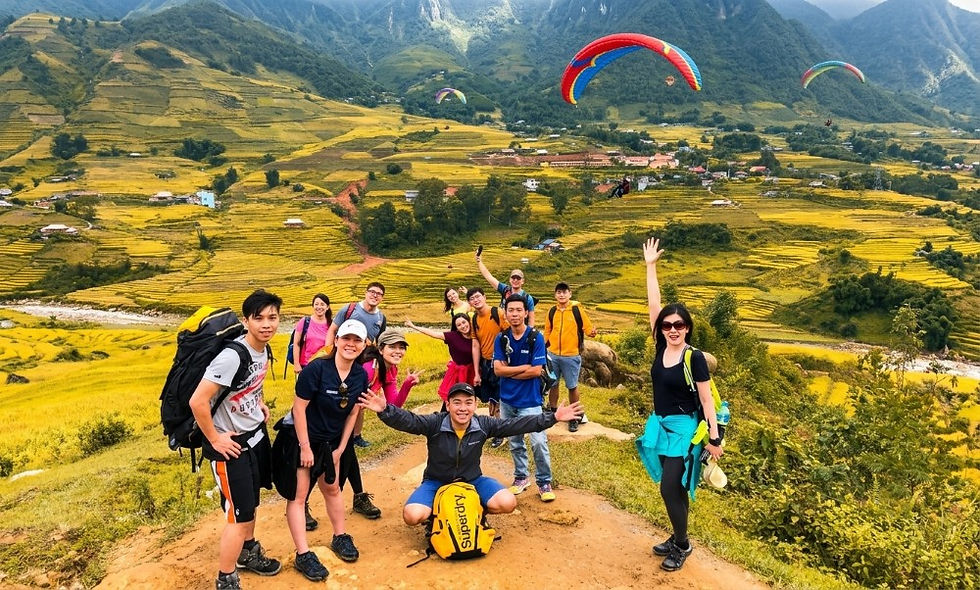
So here are the routes sorted by what they actually demand of you.
Easy – Half a Day, No Real Effort
Cat Cat
Barely a trek. A ticketed loop through a village fifteen minutes from town, mostly on paved paths and steps, done in about two hours. Fine as a first taste of the valley, but it’s a managed attraction rather than a walk in the hills – see our Cat Cat guide for what to expect.
Ham Rong
Stone steps through gardens up to a viewpoint over town, behind the church. Ninety minutes to three hours, depending on how long you stand at the top. Uphill, but there’s nothing technical about it.
Moderate – The Real Sapa Trek
Lao Chai to Ta Van
This is the one people mean when they say “trekking in Sapa”. Roughly 10–12 km through the Muong Hoa valley, four to six hours with stops, running from Sapa through Y Linh Ho and Lao Chai down to Ta Van.
It’s not steep, and it isn’t high-altitude suffering – but it is uneven. You’ll be on a mix of lanes, dirt paths, and narrow tracks cut into the terraces, and after rain the earth turns to something closer to grease than mud.

Every year, people do this in trainers with no tread and spend the afternoon sitting down harder than they planned. Shoes with grip are the entire difference between a lovely day and a miserable one.
You can shorten it: take a car to Lao Chai and walk only the gentler final section. Nobody will know.
Longer valley routes
From Ta Van you can push on to Giang Ta Chai or further down the valley. This is where a guide starts earning their money – the paths braid, signage is minimal, and it’s easy to commit to a longer day than you intended.
Hard – Fansipan on Foot
Climbing Vietnam’s highest mountain is a serious two-day undertaking with an overnight in a basic camp, real altitude, and weather that changes fast.
It needs a licensed guide and the right arrangements through the national park – this is not something you improvise on a whim from your hotel lobby.
If what you actually want is the summit rather than the suffering, the cable car gets you there in twenty minutes.

Do You Need a Guide?
On the main Lao Chai–Ta Van route in decent weather, no – plenty of people walk it unguided and are fine. Anywhere further out, in poor visibility, or on Fansipan, yes.
But there’s an argument for hiring one even on the easy route, and it isn’t about navigation. A good local guide tells you what you’re actually looking at – whose fields those are, what’s planted, why the terraces are shaped that way – and turns a nice walk into something you remember.

Just hire deliberately, through your hotel or a licensed operator, and agree on the route, the hours, and the price before you set off.
About the Women Who Walk With You
Worth knowing before it happens, because it surprises almost every first-timer. Local Hmong women often join travelers at the edge of town and walk with them for hours, chatting the whole way. It’s friendly, and it’s genuine – and at the end, there’s usually an expectation that you’ll buy something.
That isn’t a scam; it’s how a lot of families here earn. But decide early how you want to handle it rather than feeling ambushed at the end of a long walk.
If you’re happy to buy, buy. If you’d rather walk alone, say so politely at the start – not after five kilometers of someone’s time.
Tickets and Practicalities
Walking through the Muong Hoa valley usually means a ticket at the checkpoint on the way in – commonly around 75,000 VND per adult, with children less.
Checks aren’t always strict, but carry cash and ask for the official ticket. Cat Cat and Ham Rong have their own separate entry fees.

Otherwise: shoes with real grip, a waterproof layer whatever the sky says, water, sunscreen, cash for lunch, and a phone with a downloaded map.
Start early – the light is better, the paths are quieter, and the afternoon has a habit of clouding over.
When to Go
Spring and autumn give the best walking weather. The terraces are flooded and mirror-like around April to June, deep green through midsummer, and gold before the September–October harvest.
Summer is the wettest and the most slippery; winter is cold, damp, and often socked in with fog. None of it makes trekking impossible – it just changes what you see and how careful you need to be.
Walk It, Then See the Whole Thing
A day in the valley shows you the terraces from between them – close up, muddy, real. The one thing a trek can’t give you is the shape of the whole valley at once, which is what a flight over Muong Hoa is for.

Do both, and you’ve seen Sapa properly.
See flying options with Fly Sapa.


Comments