
Love Waterfall, Sapa: The Walk, the Legend, and Whether It's Worth the Ticket

Updated: Jul 30
Thác Tình Yêu is the best waterfall near Sapa - and it costs three times more than the one down the road. Here's what you get for it.
Fourteen kilometers out of Sapa, past Silver Waterfall and most of the tour buses, there's a car park with a ticket booth and a gate into the forest.
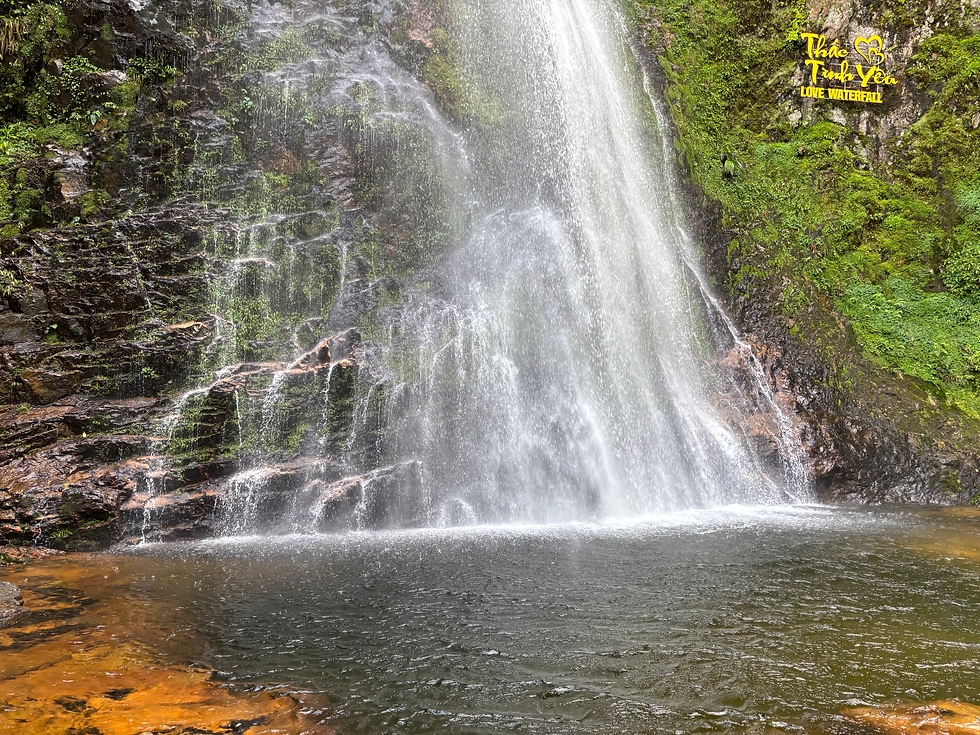
Beyond it, a stone path follows a stream uphill through bamboo. The traffic noise falls away within a minute. Twenty-five minutes later the valley narrows, the trees pull back, and a hundred meters of water come down a cliff face into a pool you can stand in.
This is Thác Tình Yêu, Love Waterfall - and it is the one worth doing properly.
The Practical Details
Vietnamese name | Thác Tình Yêu |
Location | San Sả Hồ, inside Hoang Lien National Park |
Distance from Sapa | About 14 km northwest on Highway 4D |
Travel time | 30 minutes by motorbike or car |
Entrance fee | Around 70,000–75,000 VND for adults, 30,000 VND for children |
Walk from the car park | About 1.5 km each way, 20–30 minutes |
Time needed | 1.5 to 2 hours, including the walk |
Height | About 100 meters |
Best months | May to September |
The Walk
This is the part that makes the difference, and it's why Love Waterfall justifies its ticket price when Silver Waterfall barely justifies a fifth of it.
From the gate, the path runs along the Suối Vàng - the Golden Stream - on stone paving that's been properly laid and is properly maintained. It climbs, but gently. There are wooden bridges over the water, sections where bamboo arches overhead, and a few benches where people stop without really needing to.
It takes 20 to 30 minutes each way, and almost anyone can do it. Children manage it. Older visitors manage it. It is not a trek, and nobody should sell it to you as one.
Two honest cautions. The stone is slippery when wet, and in a region where it rains most afternoons for half the year, that's most of the time - proper shoes, not flip-flops. And there are a handful of steeper stepped sections near the top that will get your heart going if you're not used to altitude. Sapa sits at 1,500 meters; the waterfall is higher.
In spring the rhododendrons along the upper path flower, which is worth timing for if you have the flexibility. March and April are the months.

What You Find at the Top
The falls come down in a broad fan rather than a single column - from a distance the shape is often described as a pair of wings or a heart, depending on how romantic the person describing it is feeling. The water originates high on Fansipan and lands in a shallow rocky basin at the base.
You can get into the pool. It is freezing, this being snowmelt and mountain runoff at altitude, and most people last about ninety seconds. Do it anyway if it's a hot day; you'll remember it.
The setting is what elevates this place. Silver Waterfall has a road in front of it. Love Waterfall has a narrow forested valley closing in on three sides, a stream running down the middle, and nothing man-made in sight except the path you walked in on. Even with other visitors around, it's quiet in a way the roadside sites are not.
The Legend
Every guide to this waterfall tells the story, usually badly and in about two sentences. It's worth more than that because it explains the name of the mountain pass you drove over to get here.
The version told locally goes like this. Seven fairy daughters of the Jade Emperor used to come down from heaven to bathe in this pool, drawn by the clarity of the water. On the mountainside above lived Ô Quy Hồ, eldest son of the mountain spirit of Ai Lao, who spent his days playing a flute.
The seventh daughter heard him. She came back the following night, and the night after, and eventually stopped pretending she was there for the water. What began as listening became something else.
Heaven noticed. Her parents forbade her from returning to the human world, and when she went anyway, the gate was closed behind her - she could not go back up, and she was not permitted to stay down. She was turned into a bird with golden feathers, condemned to circle the peak calling out his name.
The sound she makes, according to the story, is Ô Quy Hồ. That's what the pass above the waterfall is named after: a bird calling for someone it can't reach.
Make of the legend what you like. But it does mean that the pool, the stream, the waterfall, and the mountain pass are all part of a single piece of local storytelling - which is more than most tourist sites in northern Vietnam can claim.

Love Waterfall or Silver Waterfall?
The two sit two kilometers apart on the same road, and most visitors have to choose. Here's the straight comparison:
Silver Waterfall | Love Waterfall | |
Entrance | ~20,000 VND | ~70,000–75,000 VND |
Effort | Park, look up, climb some steps | 1.5 km walk each way |
Time needed | 15–30 minutes | 1.5–2 hours |
Crowds | Heavy, especially mid-morning | Noticeably thinner |
Setting | Directly beside the highway | Forested valley, no road noise |
Worth it? | In the wet season, yes. Otherwise marginal. | Yes, in almost any conditions. |
If you only do one, do Love Waterfall. It costs more and takes longer, and both of those things are the reason it's better - the walk filters out the tour groups on tight schedules, and the setting is genuinely lovely rather than merely convenient.
If you're driving past anyway, do both. Silver Waterfall is on the way and takes twenty minutes. Our full guide to Silver Waterfall covers when it's actually impressive and when it's a trickle.
Getting There
By motorbike. Take Highway 4D northwest out of Sapa toward Lai Chau, past Silver Waterfall, and watch for the signed turning on the left about two kilometers further on. Around 30 minutes from town. The road is good, and the ride is one of the best in the region.
The hazard on this road is fog, not the surface. It comes in fast and can cut visibility to a few meters. If that happens, pull over and wait it out.
Check our Sapa motorbike rental guide before you rent - particularly the section on licenses, because the wrong permit voids your travel insurance, and this is not the road to discover that on.
By taxi or private car. Sensible for groups. Agree on a round-trip fare including waiting time in advance, and make sure the driver understands you want Thác Tình Yêu, not Thác Bạc. They are different places two kilometers apart, and this confusion happens constantly.
By tour. The standard half-day O Quy Ho circuit includes it. Convenient, but you'll be on someone else's clock at the one site here where having time actually matters.
Where You Actually Are: Hoang Lien National Park
That gate you walked through is a national park boundary, and it's worth knowing what sits behind it.
Hoang Lien National Park was established in 2002 and covers just under 30,000 hectares - roughly 29,845 - straddling the provincial line between Sapa in Lao Cai and Than Uyen in Lai Chau. It runs from about 1,000 meters up to the summit of Fansipan at 3,147, and that two-kilometer vertical range is the whole reason the place matters.
Climb through it, and the forest changes underneath you. Subtropical broadleaf at the bottom, cloud forest in the middle band where the mist sits most of the year, and stunted, wind-bitten vegetation near the top. Botanists have recorded 2,847 species of vascular plants here. Of those, 149 are classed as rare, 133 appear in Vietnam's Red Book of threatened species, and 16 are at risk of disappearing globally. The rhododendrons you pass on the upper section of the Love Waterfall trail are part of that - the park holds a significant share of Vietnam's wild rhododendron species, and they flower in March and April.
The recognition follows the numbers. The IUCN lists Hoang Lien as a Centre of Plant Diversity, and in April 2006 it was designated an ASEAN Heritage Park - a regional conservation status held by only a few dozen sites across Southeast Asia.
How the park is organized. Roughly 11,800 hectares are strictly protected, with access limited to research and permitted trekking. Another 17,900 hectares are designated for ecological recovery. Beyond that sits a buffer zone of nearly 39,000 hectares, which is where most of the villages and farmland you drive past actually lie. The main entrance and ranger station is at Trạm Tôn, about 12 km from Sapa town on the same road you took to get here.
On tickets - read this carefully. The Love Waterfall entrance fee and the park's own entrance fee are quoted separately, with the park listed at around 150,000 VND for adults and 70,000 for children between 1 m and 1.3 m tall. In practice, most visitors doing the short waterfall walk pay the waterfall ticket only, and the park fee applies to trekking further in. Ask at the booth what your ticket covers before you pay, and don't be surprised if the answer varies by season and by who's on duty.
What it asks of you. Standard protected-area rules, and they're not decorative. Stay on the marked path - the vegetation either side is the thing you came to see. Take your rubbish back out with you; there's no collection past the gate. Don't pick anything, including flowers that look abundant. And if you're swimming in the pool at the base, no soap, no shampoo, nothing.

Practical Notes
Bring small notes. The ticket booth won't thank you for a 500,000 VND bill.
Shoes with grip. Non-negotiable. Wet stone, and there's always wet stone.
Rain layer from May to September. The valley funnels weather.
Bring water. There's nothing for sale past the gate.
A towel if you plan to get into the pool, and something warm for afterward.
Go early. Before 9am, the path is close to empty. The tour groups arrive between 10 and 12.
It's colder here than in Sapa town - a few degrees more in the shade of the valley.
Seeing It From Above
Standing at the base of Love Waterfall, you're at the bottom of a system you can't see the shape of. The water falls from high on Fansipan, feeds the Golden Stream, and eventually joins the river running the length of the Muong Hoa valley - the same river that made the terraced fields you drove past on the way here.
On the ground, it's a waterfall in a forest. From the air, it's one thread in a drainage pattern that covers the whole valley, with Fansipan at the head of it and the terraces stacked up on both sides.
Paragliding over Muong Hoa is the only way most visitors get to see that shape - the valley entire, the ridgelines, the villages set into the hillsides, and the highest mountain in Indochina standing over it. It's the same landscape you spent the morning walking through, and it reads completely differently from a thousand meters up.


Comments