
Silver Waterfall, Sapa: Is the 200-Meter Cascade Worth Stopping For?

An honest look at Thác Bạc - what it costs, when it's impressive, when it isn't, and how long you actually need.
Twelve kilometers northwest of Sapa town, the road to Lai Chau starts to climb. Pine forest closes in, the temperature drops a couple of degrees, and then - on your right, impossible to miss - a white ribbon of water comes down the mountainside straight at the tarmac.
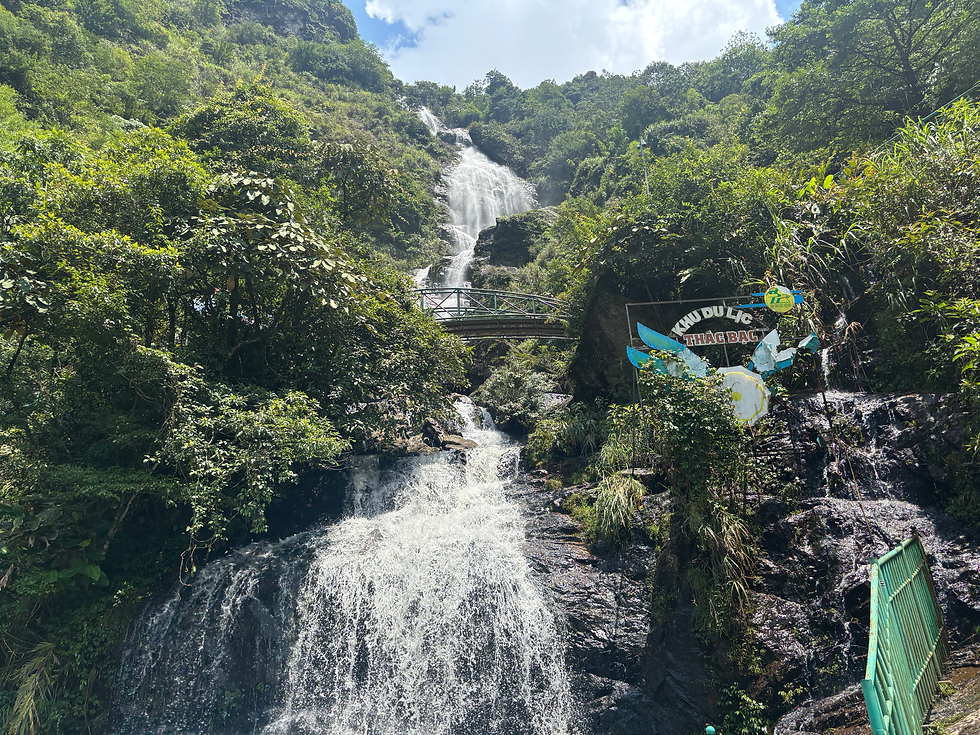
That's Thác Bạc, Silver Waterfall. Almost every tour bus, motorbike, and private car heading over O Quy Ho Pass stops here, which tells you something about how convenient it is and something else about how crowded it gets.
Here's the part most guides skip: whether Silver Waterfall is worth your money depends almost entirely on when you show up. In August it's genuinely impressive. In February it's a trickle down a rock face with a ticket booth in front of it. This guide is about telling those two situations apart before you've paid.
The Practical Details
Vietnamese name | Thác Bạc |
Distance from Sapa | About 12 km northwest on Highway 4D (QL4D) |
Travel time | 25–30 minutes by motorbike or car |
Entrance fee | Around 20,000 VND adults, 10,000 VND children |
Opening hours | Roughly 8:30–17:00 |
Time needed | 15–30 minutes |
Height | Around 200 meters, top to bottom |
Best months | May to August |
What You Actually See
The falls drop off the shoulder of a mountain on the Lao Cai–Lai Chau provincial border and land in a stream that runs under the highway. From the car park, you're looking almost straight up at them.
A concrete-and-stone staircase climbs the left side of the cascade to a viewing platform roughly halfway up, and a short bridge crosses in front of the lower pool. That's the whole site. The climb is steep but genuinely short - a few minutes if you're moving, longer if you stop for photos, which everyone does. The steps are well maintained and have railings, but they're wet, and wet stone in Sapa is slick. If your knees are unhappy about stairs, the view from the bridge at the bottom is honestly not much worse than the one from the top.
At the base, the spray reaches you, and on a hot day, that's the best thing about the place. Vendors at the bottom sell grilled corn, sweet potatoes, sticky rice in bamboo, and Hmong textiles of varying authenticity. The corn is good.

The Honest Verdict
Silver Waterfall is pleasant. It is not extraordinary, and it is not the best waterfall in Sapa.
That title belongs to Love Waterfall, fourteen kilometers up the same road, which requires a 25-minute walk through the forest and rewards you with something considerably more atmospheric. Silver Waterfall's advantage is that it takes almost no effort - you park, you look up, you climb some steps, you leave. Its disadvantage is the same thing. There is no journey, no discovery, no moment where the trees open up. It is a waterfall next to a road.
In the rainy season, that's still enough. From May to August, the volume is serious, the noise carries over the traffic, and the spray drifts across the car park. People come away impressed.
Outside those months, be realistic. From November through March, the flow thins considerably. You are paying a small fee to look at something you can already see clearly from the road. Some visitors find this annoying; others shrug, because the fee is roughly the price of a coffee.
There's a compensation in winter, though, and it's an odd one: this is one of the coldest spots in the region, and in a hard cold snap the rocks and vegetation around the falls can frost over. Vietnam does not have many places where that happens, and Vietnamese visitors travel a long way to see it. If you happen to be in Sapa during a cold spell, Silver Waterfall becomes a genuinely unusual sight - and considerably more crowded.
Our recommendation: treat Silver Waterfall as a stop, not a destination. Fold it into a day on O Quy Ho Pass, give it twenty minutes, and spend your remaining time and money on Love Waterfall further up the road.

When to Go - and When Not To
By season. May to August is peak flow. September and October give you decent water with better weather and thinner crowds - arguably the best compromise. November to April is the weak period, and January and February are the weakest.
By time of day. Get there before 9:30am if you can. The Sapa tour buses run a standard circuit - Silver Waterfall, then Love Waterfall or the Heaven Gate viewpoint, then back - and they arrive in a clump mid-morning. Before that, the car park is nearly empty, and you can photograph the falls without a queue for the bridge.
Late afternoon works too, after the buses have turned back toward town. The light on the water is better then, though the valley shades over early.
Avoid Vietnamese public holidays entirely, especially the 30 April–1 May break and the 2 September National Day. Sapa is a domestic tourism magnet, and the roadside attractions absorb the overflow.
Getting There
By motorbike. The best option, and the ride, is a large part of the point. Head northwest out of Sapa on Highway 4D toward Lai Chau. The road is well-surfaced, wide, and climbs steadily through pine forest. You'll see the "Khu du lịch Thác Bạc" signboard on your right about 25 minutes out; there's parking directly opposite.
Fog is the real hazard here, not the road surface. It rolls in fast and can drop visibility to a few meters unexpected. If it closes in, pull over and wait - the locals do.
Before you rent, check our guide to motorbike rental in Sapa, which covers prices and the license rules that void your travel insurance if you get them wrong. This matters more than most visitors realise.
By taxi or private car. Straightforward and worth it if there are three or four of you. Agree on a round-trip price with waiting time before you set off, and be specific that you want Thác Bạc - there are several waterfall sites on this road, and drivers will take you to whichever one they prefer.
By tour. Every agency in Sapa sells a half-day O Quy Ho circuit that bundles Silver Waterfall, Love Waterfall, and the Heaven Gate viewpoint. Efficient, cheap, and you'll arrive at each stop at the same time as five other minibuses.
By bus. Don't count on it. There's no reliable scheduled service to the waterfall itself, and what does run drops you short of the entrance.

Making a Day of It
Silver Waterfall sits in the middle of the best stretch of road near Sapa, and going all that way for a twenty-minute stop is a waste of the drive. Continue up the same highway, and you get, in order:
Love Waterfall - 2 km further on, then a 1.5 km walk into Hoang Lien National Park. A hundred-meter cascade at the head of a bamboo-lined valley, and the traditional starting point for one of the trekking routes up Fansipan. Higher entrance fee, considerably better experience.
O Quy Ho Heaven Gate - the top of the pass at around 2,000 meters, on the provincial border. On a clear day you look down the far side into Lai Chau province; in bad weather you look at cloud, which is its own kind of impressive.
Rong May Glass Bridge - over the pass on the Lai Chau side. A glass walkway cantilevered off a cliff, reached by a lift through the rock. Divisive, but memorable.
Done properly, that's a comfortable half day and one of the better road trips in northern Vietnam. Our two-day Sapa plan fits the whole circuit into an afternoon without rushing.
Practical Notes
Bring small notes. The ticket booth is not enthusiastic about breaking large bills.
Wear shoes with grip. The steps stay wet even when it hasn't rained because of the spray.
Bring a rain layer between May and September. Sapa weather turns in minutes, and the pass is exposed.
Phone signal is patchy along this stretch. Screenshot your map before you leave town.
Toilets are at the car park, and there's a small charge.
It's colder here than in town - usually two or three degrees more at the top of the pass. Take a layer even on a warm day.
The Bigger View
Here's a thought worth sitting with. Silver Waterfall drops around 200 meters down the flank of the Hoang Lien Son range, and from the road, it looks enormous. Fansipan, the peak behind it, rises to 3,147 metres - the highest point in Indochina.
From the ground, that scale is difficult to take in. You see one waterfall, one bend of road, one wall of forest.
From the air, you see the system. Paragliding over the Muong Hoa valley puts the whole landscape in front of you at once - the terraces stacked up the valley sides, the streams that feed cascades like this one, and the ridgeline running away toward Fansipan. It is the same mountain range you've been driving through all morning, except suddenly you can read it.
If you're already spending the day on this road, it's worth knowing that the view from above is available too.


Comments