
Sapa vs. Ha Giang: Which One Fits Your Trip?

Pick Sapa if you have 2–3 days, don't ride a motorbike, are traveling with kids or parents, or want a comfortable base with a range of activities you can do on your own schedule.
Pick Ha Giang if you have at least 4 days, want the road itself to be the experience, and are happy on the back of a bike sleeping in basic homestays. Sapa is a destination; Ha Giang is a journey - that single distinction decides it for most people.

Both are in the far north of Vietnam, both are mountains and rice terraces, and both are roughly six hours from Hanoi. That's where the similarity ends.
Sapa vs. Ha Giang
Sapa | Ha Giang | |
What it is | A mountain town with attractions around it | A 350 km motorbike loop through karst mountains |
Minimum time needed | 2 days (3 is comfortable) | 4 days (3-day loop + travel) |
From Hanoi | 5.5–6 h limousine bus, or 8 h sleeper train to Lao Cai + 1 h road | 6–6.5 h bus (no railway, no full expressway) |
Cost, 3 days | ~$120–200 all-in | ~$180–280 all-in |
Physical demand | Low to moderate - you choose | Moderate to high - 5–7 h on a bike daily |
Accommodation | Hostels to 5-star resorts | Homestays, mostly shared, basic |
Riding license needed | No | Yes, if self-driving (see below) |
Extra paperwork | None | Border-area permit, ~$8–10 |
Crowds | Heavy in town, thin 3 km out | Moderate, but the loop is now well traveled |
Best months | Sep–Nov, Mar–May | Sep–Nov (buckwheat late Oct–mid Nov) |
Paragliding | Yes - tandem flights, $95 | No commercial tandem operation |
How Hard is Each One to Reach?
Sapa is the easier arrival by a clear margin. Limousine vans run from Hanoi in 5.5–6 hours for $13–18 one way, direct to the town center, with no transfer at the other end. The overnight train to Lao Cai takes about 8 hours ($22–65 depending on cabin) plus roughly an hour by road up to Sapa - slower, but you sleep through it and don't lose a day.
Ha Giang city is about 6–6.5 hours by bus for $9–20, but that's only the start. There's no railway and no continuous expressway on this route, and Ha Giang city itself is not the attraction - you still have to get on the loop, which is another 3–4 days. Budget a full day of travel at each end.

Practical note: since the July 2025 provincial reorganization, Ha Giang is administratively part of Tuyen Quang province, and Sapa sits in the enlarged Lao Cai province. Older maps, insurance forms, and booking sites still use the old names. Nothing changes on the ground, but don't panic if the paperwork looks wrong.
Do You Need a Motorbike License?
For Sapa, no. Everything can be done on foot, by taxi, by cable car, or with a driver.
For Ha Giang, this is the question that catches most travelers out. To legally ride yourself, you need an International Driving Permit issued under the 1968 Vienna Convention, carried with your home license. IDPs issued under the older 1949 Geneva Convention - the kind issued in the USA, Canada, Australia, and New Zealand - are not recognized in Vietnam.
If you hand one over at a checkpoint, you are treated as unlicensed, which means a fine, possible impoundment of the bike, and near-certain invalidation of your travel insurance if you crash.
Police checks are real, not theoretical; the Bac Sum and Yen Minh passes are known for document checks. The legal workaround is simple and popular: ride as a passenger behind a local driver on an "easy rider" tour. Expect $150–220 for 3 days / 2 nights, including bike, driver, homestays, meals, and guide.
Self-drive guided tours run cheaper, around $120–150, but only make sense if your license is valid.

Since 1 June 2026, foreigners entering Ha Giang's border areas also need a permit, around $10. Any reputable tour operator handles this for you; independent riders should sort it in Ha Giang City before setting off.
What Do You Actually Do In Each Place?
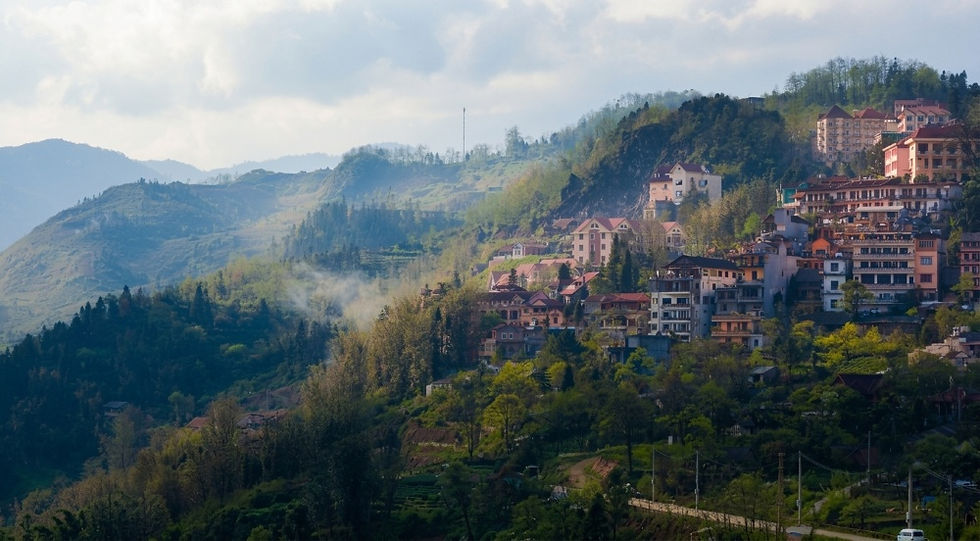
In Sapa, you build your own days. Trekking through the Muong Hoa valley to Lao Chai, Ta Van and Giang Ta Chai is the core of it - half-day or full-day, with or without a local Hmong or Dao guide.
Beyond that: the Fansipan cable car to Vietnam's highest point (~$32 on weekdays and Sundays, ~$34 Saturdays and holidays in 2026; ~$20 for children 1.0–1.4 m, return ticket, valid same day only), the Muong Hoa mountain train up to the cable car station (~$8 return), the O Quy Ho pass, and tandem paragliding over the valley. You can be as active or as lazy as you want, and you can change your mind at breakfast.
In Ha Giang, you do one thing: the loop. Three or four days riding the Quan Ba Heaven's Gate, the Dong Van karst plateau, Ma Pi Leng pass - arguably the most spectacular stretch of road in Vietnam - and a boat on the Nho Que river below it.
It's a fixed route on a fixed schedule with a group, and that's the point. There is no menu to choose from and no opting out on day two when your legs hurt.
Which is More Expensive?
Ha Giang, in almost every scenario - the tour price bundles four days you can't unbundle.
Item | Sapa (3 days) | Ha Giang (4 days) |
Transport from Hanoi, return | $26–36 | $18–40 |
Accommodation | $10–60/night (huge range) | Included in tour |
Tour/activities | Pay per item | $150–220 (3D2N) |
Permit | - | ~$10 |
Food | $10–20/day | Mostly included |
Realistic total | $120–200 | $180–280 |
Sapa's advantage is elasticity: you can do it on $40 a day or $250 a day. Ha Giang has a floor you can't get under because you're buying a package.
When Should You Go?
The two peak seasons overlap, which is why so many people try to fit both in.
Months | Sapa | Ha Giang |
Dec–Feb | Cold, 0–10 °C, fog, occasional frost; quiet, dramatic | Cold and often fogged in; poor views on the passes |
Mar–May | Excellent - green terraces, wildflowers, stable air | Good, warming up |
Jun–Aug | Rain, mud, leeches on trails; terraces are vivid green | Rainy season; landslide risk on the loop |
Sep–Nov | Best - golden harvest (Sep), clear stable skies, prime flying conditions | Best - 12–24 °C, dry, clear; buckwheat flowers late Oct to mid Nov |
If you only have one window, September to November serves both. Rice harvest in Sapa peaks in September; the Ha Giang buckwheat bloom peaks from late October into mid November. Fit them in that order, and you get both at their best.
Where Ha Giang Genuinely Wins
An honest comparison has to say this plainly, because it's true:
Scenery per hour. Ma Pi Leng and the Nho Que gorge are on a scale Sapa doesn't have. Nothing in Sapa matches that specific view.
Less commercial. Sapa town has hotels, karaoke, construction, and persistent vendors. Ha Giang's villages don't, yet.
The social side. Loop groups eat, ride, and drink together for three days. Solo travelers routinely rate it their best experience in Vietnam, and much of that is the people, not the road.
Sense of achievement. You finish the loop having done something. You finish a Sapa trip having been somewhere.
Where Sapa Wins
Flexibility. Two days, three days, a week - Sapa scales. The loop doesn't.
Accessibility. Kids, parents, limited mobility, no riding experience, bad knees: Sapa still works. Ha Giang mostly doesn't.
Comfort. Real hotels, good coffee, restaurants, and a hot shower after trekking. Loop homestays are mattresses on a shared floor.
You can bail. Bad weather on day two in Sapa means a cable car or a café. Bad weather on day two of the loop means riding through it.
Air, not just road. Sapa is the only place in northern Vietnam with regular commercial tandem paragliding. Take-off is at 1,750 m with about 750 m of vertical over the Muong Hoa valley; flights average 12–15 minutes, and it costs $95 per person.
It's the one thing on either itinerary that shows you the terraces from above - and it takes half a morning, so it fits around everything else.
Can You Do Both in One Trip?
Yes, and it's the right answer if you have 7+ days. The overland route between them (Sapa – Bac Ha – Ha Giang) takes 6–7 hours on mountain roads and is scenic in its own right, though it's a long day and not every operator runs it daily. Many travelers instead route back through Hanoi, which is slower on paper but easier to book.
A workable 7-day shape: 2 nights in Sapa (trek, fly, Fansipan) → transfer day → 4 days Ha Giang loop → back to Hanoi.
Do Sapa first - you'll arrive fresher for the trekking and the flying, and the loop is a better note to end on.
If you have 4–5 days, don't split it. Rushing both means two shallow versions of two good trips.
FAQ
Is Sapa worth visiting if I'm already doing Ha Giang?
Yes, if you have the days for it - they're different experiences, not competing versions of the same one. Sapa gives you valley trekking, Vietnam's highest peak, and tandem flying; Ha Giang gives you the road. If you only have five days total, pick one.
Which is better for a first-time visitor to Vietnam?
Sapa. It's easier to reach, easier to book late, easier to adjust, and doesn't require a license or permit. Ha Giang rewards travelers who've already found their feet in Vietnam.
Can you do the Ha Giang loop without riding a motorbike yourself?
Yes. Easy rider tours put you on the back of a bike with a professional local driver for $150–220 over 3 days / 2 nights. This is also the only legal option for riders holding a 1949 Geneva Convention IDP - the type issued in the USA, Canada, Australia, and New Zealand.
Is Sapa too touristy?
The town center is genuinely crowded and heavily built up. The valley is not. Walk or ride 3–4 km out toward Ta Van or Giang Ta Chai, and the crowds fall away almost entirely - and from the air, they disappear completely.
Which has better weather in November?
Both are good. Ha Giang runs 12–24 °C, dry and clear with buckwheat in bloom. Sapa is cooler and can fog in the mornings, but November afternoons are among the most stable flying conditions of the year.


Comments